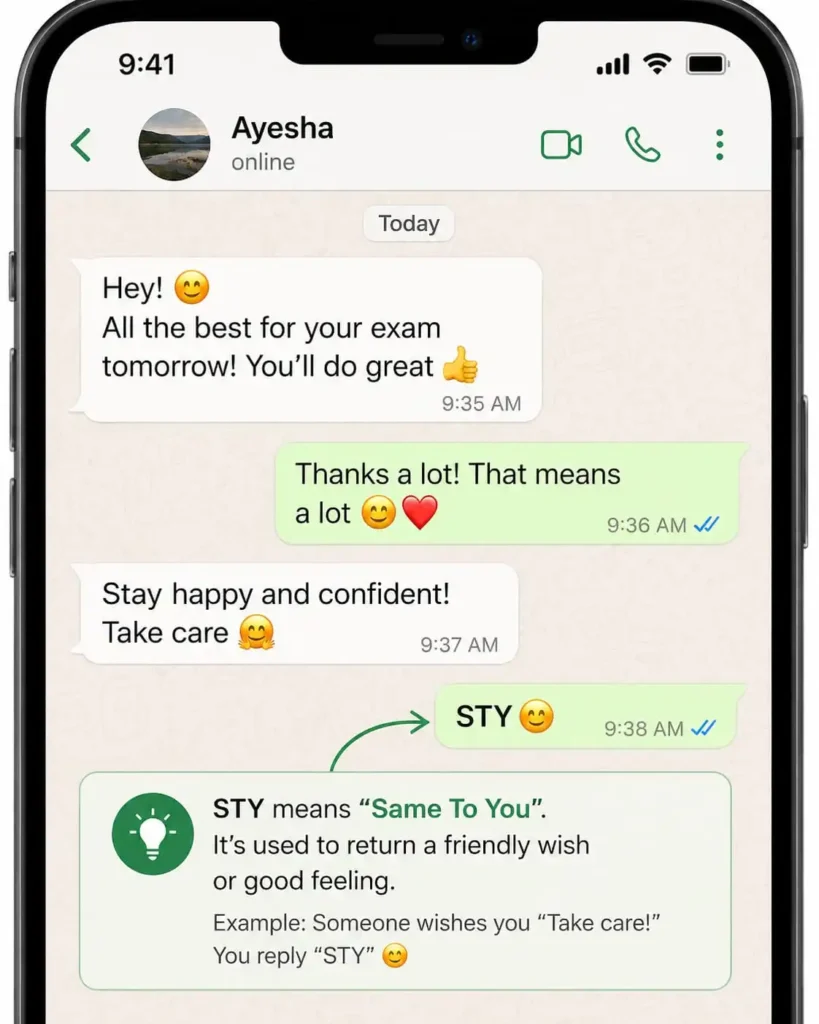

Have you ever received a short message like “STY” and wondered what the person was actually trying to say? Texting abbreviations can be confusing because a few letters can replace an entire phrase, and their meaning often depends on what was said immediately before them. If you’re searching for STY mean in text, the good news is that the most common interpretation is fairly simple.
In casual texting, STY usually means “Same To You.” People use it as a quick way to return a greeting, compliment, good wish, or positive message. Instead of typing “Same to you!” in full, someone can simply reply with “STY” and keep the conversation short and casual.
For example, if someone texts “Have a great day!”, replying “STY 😊” means “Same to you.” The abbreviation doesn’t normally carry a complicated hidden meaning. Its purpose is simply to return the same positive feeling or wish to the other person.
What Does STY Mean in Text?
When people ask what STY means in text, they are usually asking about the abbreviation’s most common texting definition. In casual conversations, STY stands for “Same To You.” It is generally used as a response when someone has wished you something positive or said something nice to you.
For example, imagine that a friend sends you, “Good luck with your interview tomorrow!” You could reply, “STY!” if you also want to wish them good luck. In this situation, STY saves you from typing the complete phrase while still making your response understandable.
The abbreviation is especially natural in quick digital conversations. People often shorten words and phrases when texting because they want to respond quickly. STY fits into that style because it communicates a familiar expression using only three letters.
Simple meaning:
STY = Same To You
Depending on the sentence, it can naturally be understood as:
- Same to you.
- You too.
- I wish you the same.
- Same wishes to you.
- Thank you, and the same to you.
The exact wording may change, but the basic idea remains the same.
What Does STY Stand For?
STY stands for “Same To You.” It is an informal abbreviation used in digital communication, particularly when someone wants to return a positive message without writing a longer response.
Suppose your friend says, “Enjoy your weekend!” You might answer, “STY 😊.” You’re not introducing a new topic. You’re simply returning the same wish. That’s what makes STY different from abbreviations that communicate an entirely separate idea.
The phrase can also be used after compliments. If someone says, “You look great today!”, replying “STY!” could mean that you are returning the compliment. However, the context needs to make that interpretation natural.
Because STY mean in text is generally connected with returning a positive statement, it usually has a friendly and polite feeling. It isn’t normally an aggressive, negative, or insulting abbreviation.
STY Meaning in a Text Message
In an ordinary text message, STY works as a quick reciprocal response. It can be used after greetings, congratulations, good wishes, compliments, holiday messages, or other positive statements.
For example:
Person A: Have an amazing weekend!
Person B: STY! 😊
Here, STY means “Same to you.”
Another example:
Person A: Good luck with your presentation!
Person B: STY!
The second person is returning the good-luck wish.
This is why understanding what STY mean in text becomes much easier when you look at the message immediately before it. The abbreviation usually doesn’t need a complicated interpretation. The surrounding conversation often tells you exactly what the sender means.
What Does STY Mean in Chat?
In chat conversations, STY is generally used as a quick response rather than as the beginning of a new sentence. Someone may type it alone or combine it with an emoji or another short phrase.
For example:
“Have a nice evening!”
“STY ❤️”
Or:
“Enjoy your vacation!”
“STY, hope you have fun too!”
The second example shows that STY can also appear alongside a longer sentence. It doesn’t have to replace the entire response.
Because chat language is informal, people may not follow standard grammar when using abbreviations. You may see STY, sty, or STY! depending on the person’s typing style. The capitalisation generally doesn’t change the meaning.
Where Is STY Commonly Used?
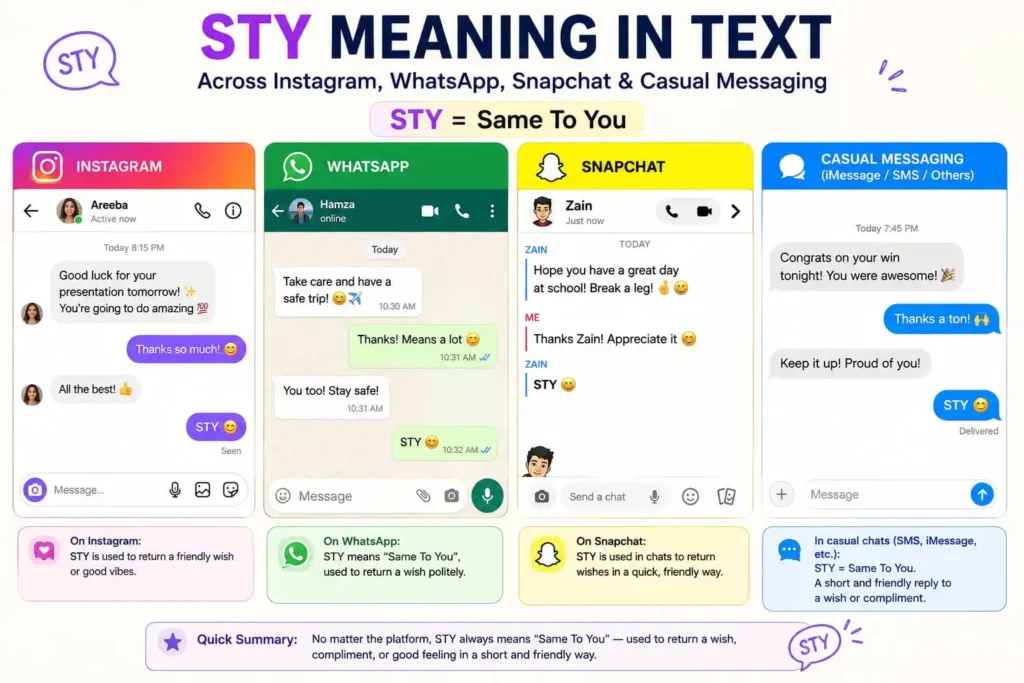
You can encounter STY in many forms of casual digital communication. It isn’t limited to traditional SMS texting. People may use the abbreviation wherever short, informal messages are common.
You may see STY mean in text conversations on:
- Text messages
- Instagram DMs
- Snapchat
- Facebook Messenger
- TikTok chats
- Discord
- Online gaming chats
- Group conversations
The important factor isn’t really the platform. It’s the informal nature of the conversation.
For example, someone might use STY on Instagram after receiving a “Happy Birthday” message, while another person may use it on WhatsApp after someone says, “Have a good night.” The context changes, but the basic meaning remains the same.
Examples of STY in Text Conversations
One of the easiest ways to understand STY meaning in text is to see how it works in realistic conversations. The abbreviation usually appears as a response to something positive, so the message before STY is often the biggest clue.
Example 1: Good Wishes
Friend: Good luck on your exam! 🍀
You: STY!
Meaning: Same to you.
Example 2: Weekend Greeting
Friend: Have a relaxing weekend!
You: STY 😊
Meaning: Same to you.
Example 3: Birthday
Friend: Happy Birthday! Hope you have an amazing day. 🎂
You: Thank you! STY when your birthday comes!
Here, STY returns the good wishes.
Example 4: Holiday Greeting
Friend: Merry Christmas! 🎄
You: STY! ❤️
Meaning: Same to you.
Example 5: Vacation
Friend: Enjoy your trip!
You: STY, have fun this weekend!
Here, the sender returns the positive wish and adds another response.
Example 6: Compliment
Friend: You look amazing today!
You: STY! 😊
In this context, the response can function as a returned compliment.
Example 7: Good Night
Friend: Sleep well tonight!
You: STY ❤️
The sender is essentially saying, “Same to you.”
These examples show why context matters when interpreting texting abbreviations.
What Does STY Mean From a Friend?
If a friend sends you STY, the message is usually friendly and straightforward. They may be returning something nice you just said, such as a greeting, compliment, or good wish.
For example, if you text your friend “Have a safe trip!” and they respond with “STY!”, they’re returning the same wish to you. They may mean, “Same to you,” even if you’re not travelling. In some conversations, they may simply be using STY as a quick way of saying “you too.”
The tone is usually relaxed rather than formal. Friends often use abbreviations because they already understand each other’s texting habits, so there is less need to spell everything out.
If someone you’re not familiar with sends STY, you can still usually understand it from the context. Look at the message that came immediately before it and ask yourself whether a “same to you” response would make sense.
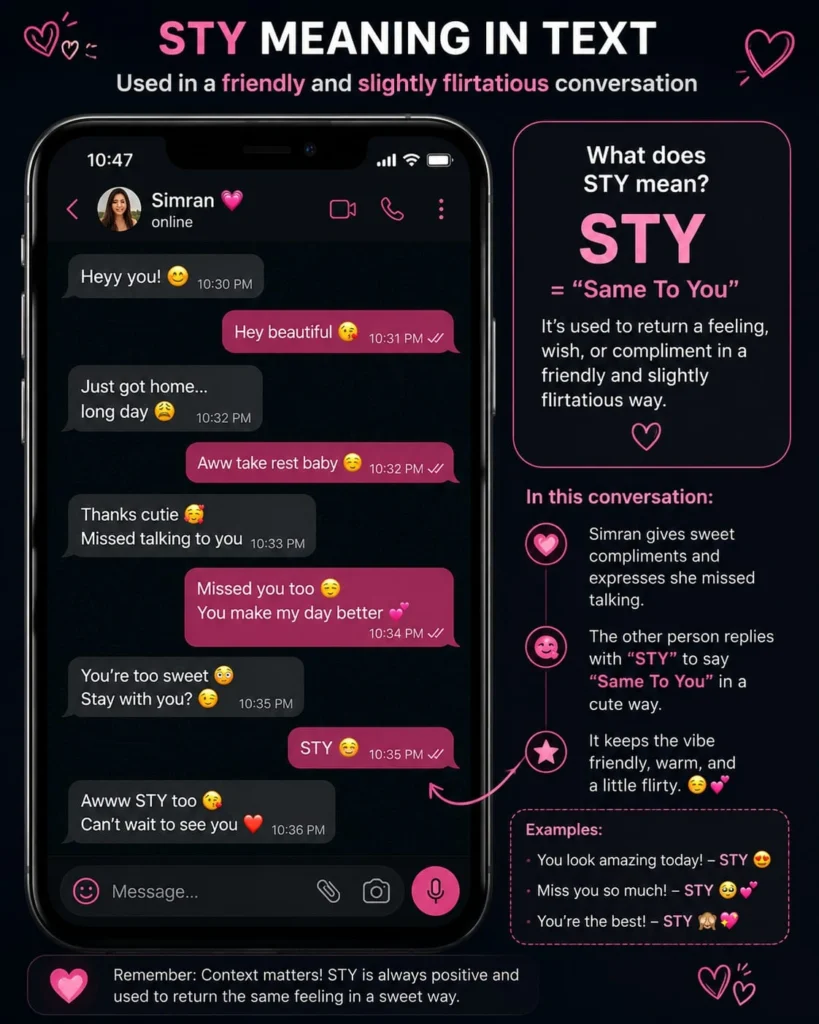
Is STY Friendly or Flirty?
STY is generally friendly and casual, not automatically flirty. The abbreviation itself does not normally communicate romantic interest. However, it can appear inside a conversation that is already playful, affectionate, or romantic.
For example:
Person A: Hope you have sweet dreams tonight 😉
Person B: STY ❤️
The heart emoji and the wording around STY create a romantic tone. The abbreviation itself still basically means “Same to you.”
This distinction is useful because people sometimes assume that any short reply from a romantic interest must have a hidden meaning. In reality, STY mean in text generally refers to the literal phrase “Same To You.” The relationship and surrounding messages determine whether the conversation feels friendly, flirty, or affectionate.
Is STY Formal or Informal?
STY is informal texting language. It works best when you’re talking casually with friends, family members, classmates, or people who are already comfortable with abbreviations.
You generally shouldn’t use STY in professional situations such as:
- Job applications
- Formal emails
- Business proposals
- Client communication
- Academic writing
- Official letters
- Workplace documents
Instead of writing “STY” in a professional conversation, write the complete phrase. For example, “Thank you, and the same to you” sounds much more appropriate in a formal setting.
Using an abbreviation isn’t automatically wrong, but the communication style should match the situation. Casual texting allows shortcuts, while professional communication usually benefits from clarity and complete sentences.
When Should You Use STY?
You can use STY when someone has said something that you genuinely want to return. It is especially natural when the other person’s message contains a wish, greeting, or positive statement.
For example, STY can work after:
- Have a great day!
- Good luck!
- Enjoy your weekend!
- Happy Birthday!
- Have a safe journey!
- Merry Christmas!
- Hope you have fun!
- Take care!
- Have a wonderful evening!
In each case, STY can communicate the idea of “Same to you.”
Before using it, however, consider whether the other person understands texting abbreviations. If you’re speaking to someone who prefers formal language, spelling out the phrase may be clearer.
When Should You Not Use STY?
Although STY is convenient, there are situations where it may sound confusing or inappropriate. The biggest issue is formality.
If you’re responding to a professor, employer, client, customer, or professional contact, a complete response is usually better. Writing “STY” may appear too casual, especially if the person doesn’t regularly use internet slang.
You should also avoid relying on STY when the context doesn’t clearly support “Same To You.” If the person has written something unrelated to a greeting or positive wish, the abbreviation may be confusing.
In those situations, simply write what you mean. Clear communication is more important than saving a few keystrokes.
Other Meanings of STY
Although “Same To You” is the most relevant interpretation in casual texting, abbreviations can sometimes have different meanings. STY may be interpreted differently depending on the topic, community, or sentence in which it appears.
For example, in a conversation about fashion, “sty” could potentially be a shortened form or reference to “style.” In another context, STY might be an acronym unrelated to texting slang altogether.
That’s why you shouldn’t automatically assign the same meaning to every occurrence of STY.
If someone writes:
“Have a great weekend! STY!”
the meaning is very clearly “Same to you.”
But if someone writes:
“I like your sty.”
the surrounding sentence may suggest that they are using the letters differently.
So when you’re trying to understand what STY mean in text, always consider the sentence, topic, and relationship between the people involved.
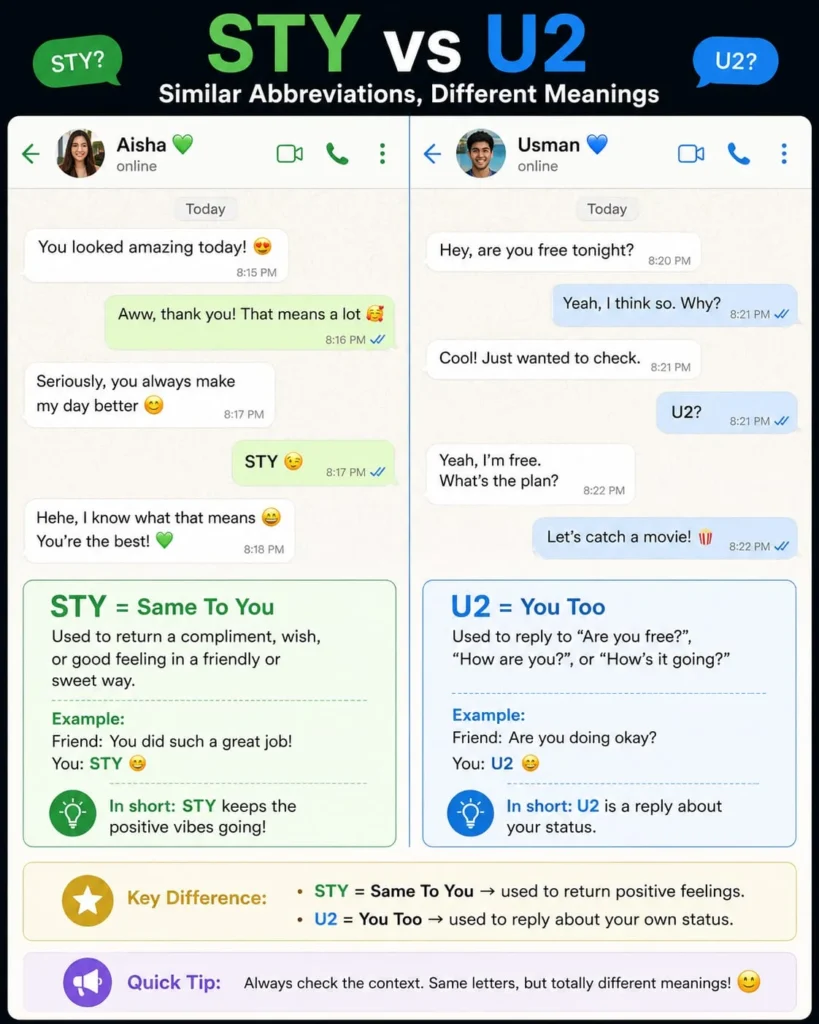
STY vs U2: What’s the Difference?
STY and U2 can sometimes serve a very similar purpose.
STY = Same To You
U2 = You Too
For example:
Person A: Have fun tonight!
Person B: STY!
Or:
Person A: Have fun tonight!
Person B: U2!
Both responses return the positive wish.
The difference is mainly wording and style. STY directly abbreviates “Same To You,” while U2 represents the sound and wording of “You Too.” Both are casual and commonly understandable in informal digital conversations.
STY vs TY
Another abbreviation you may see around the same type of conversation is TY, which means “Thank You.”
These two abbreviations serve different purposes.
TY → Thank You
STY → Same To You
For example:
Person A: Have a great day!
Person B: TY!
This means the person is thanking the sender.
But:
Person A: Have a great day!
Person B: STY!
This means the person is returning the same wish.
You may even see both together:
“TY! STY 😊”
That could mean “Thank you! Same to you.”
How to Reply When Someone Says STY
If someone sends you STY, you don’t necessarily need to respond again. The abbreviation is often already a complete response.
However, if you want to continue the conversation, you can answer naturally.
For example:
Them: Have a great weekend!
You: STY! What are you doing this weekend?
Or:
Them: Good luck tomorrow!
You: Thanks! STY if you have your exam too.
You can also simply respond with an emoji if the conversation is already casual.
The important thing is to understand that STY is usually a reciprocal response. It doesn’t normally ask you a question or introduce a new subject.
How Do You Know What STY Means From Context?
Context is one of the most useful tools for understanding texting abbreviations. If you receive a message containing STY and you’re unsure about it, read the messages immediately before and after it.
Ask yourself:
- Was the person giving me a greeting?
- Did they wish me good luck?
- Did they compliment me?
- Were they talking about a holiday or special occasion?
- Would “same to you” make sense as a response?
If the answer is yes, “Same To You” is probably the intended meaning.
For example:
“Have a wonderful evening!” → “STY!”
There is very little ambiguity here.
However, if STY appears in a conversation about something completely unrelated, consider whether it might be a different abbreviation or shortened word.
Why Do People Use STY in Texting?
The main reason people use STY is convenience. Digital conversations often move quickly, and people naturally shorten phrases that they use frequently.
Typing three letters is faster than typing “Same to you.” While the time saved is small, abbreviations become useful when people are sending dozens of messages throughout the day.
STY also keeps the tone casual. A full sentence such as “I wish you the same” may sound overly formal between close friends. A simple “STY 😊” feels more natural in a casual chat.
This is part of a broader pattern in online communication. People commonly use abbreviations such as LOL, BRB, BTW, IDK, TY, WYD, and U2 to make conversations faster and more relaxed.
Is STY Still Used?
You may still encounter STY in casual digital conversations, although not everyone uses the abbreviation. Internet language changes constantly, and different age groups, communities, and platforms can develop different texting habits.
Some people may prefer “you too” because it’s already short and familiar. Others may use “U2” or simply write “same!”
That doesn’t mean STY is meaningless or impossible to understand. It simply means texting vocabulary isn’t standardised. The same person may use abbreviations frequently in one conversation and type complete sentences in another.
If you don’t recognise STY when someone sends it to you, don’t worry. Looking at the surrounding message will usually make the intended meaning obvious.
Common Mistakes When Understanding STY
One common mistake is assuming that STY has only one possible meaning in every context. While “Same To You” is the main texting interpretation, abbreviations can have different meanings depending on the conversation.
Another mistake is assuming that STY is automatically romantic. It isn’t. Someone saying “STY ❤️” may be affectionate, but the heart emoji and conversation create that tone—not the abbreviation itself.
People also sometimes confuse STY with TY. Remember:
TY = Thank You
STY = Same To You
Understanding these small differences can prevent awkward replies and make online conversations much easier to follow.
What Does STY Mean on Snapchat?
On Snapchat, STY can be used in the same casual way as it is in ordinary texting. Someone may send it after receiving a greeting, wish, or compliment.
For example:
“Have fun tonight! 👻”
“STY!”
The intended meaning is likely “Same to you.”
Snapchat encourages quick conversations, so abbreviations fit naturally into the platform’s communication style. However, the meaning isn’t unique to Snapchat. If the same message appeared on WhatsApp, Instagram, or SMS, the interpretation would generally remain the same.
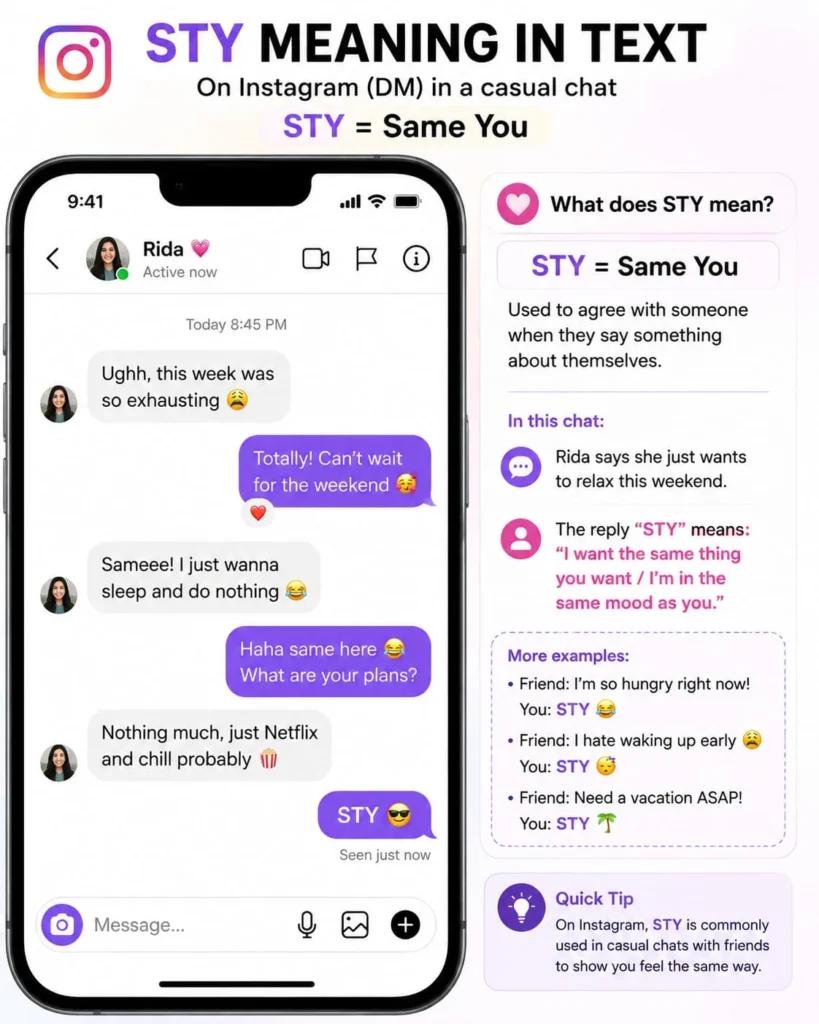
What Does STY Mean on Instagram?
On Instagram, STY may appear in DMs, replies, comments, or casual conversations. If someone sends it after a positive statement, “Same To You” is usually the most natural interpretation.
For example:
“Hope you have an amazing day! ❤️”
“STY 😊”
The person is returning the same wish.
As with other platforms, context matters. Instagram has a mixture of casual, professional, public, and private communication, so the meaning can occasionally depend on how the letters are being used.
STY Meaning in Simple Words
In simple words, STY means “Same To You.” It is a short and informal way of returning someone’s greeting, wish, compliment, or positive message.
If someone tells you:
“Have a great day!”
and you reply:
“STY!”
you’re simply saying:
“Same to you!”
The abbreviation is friendly, quick, and mostly suitable for casual digital conversations.
So if you see STY mean in text while reading a message, start by checking whether the person is responding to a positive statement. If they are, “Same To You” is probably exactly what they mean.
Final Thoughts
STY most commonly means “Same To You” in text conversations. People use it as a quick way to return a greeting, compliment, good wish, or positive message without typing the complete phrase. It is particularly suited to casual texting and social-media conversations where short responses are common.
The easiest way to understand STY is to look at the message around it. If someone says “Good luck,” “Have a great day,” “Enjoy your weekend,” or “Have fun,” an answer such as “STY!” naturally means “Same to you.”
Remember that STY is informal, so it isn’t the best choice for professional emails, academic writing, or official communication. In those situations, writing “Same to you” or “Thank you, and the same to you” is clearer and more appropriate.
And if the abbreviation appears in an unusual context, don’t immediately assume the meaning. Texting abbreviations can vary, so the surrounding conversation is always your best clue.
FAQs:
What does STY mean in text?
STY usually means “Same To You.” It is an informal abbreviation used to return someone’s greeting, good wish, compliment, or positive message.
What does STY stand for?
STY commonly stands for “Same To You.” It is mainly used in casual texting and online conversations.
Is STY a slang word?
STY is better described as an informal texting abbreviation. It is commonly used in casual digital communication rather than formal writing.
What does STY mean on Snapchat?
On Snapchat, STY usually means “Same To You.” Someone may use it to return a greeting, compliment, or good wish.
What does STY mean on Instagram?
On Instagram, STY generally means “Same To You” when it appears as a response to a positive message in a DM, reply, or casual conversation.
Is STY the same as U2?
They can have a very similar meaning. STY means “Same To You,” while U2 means “You Too.” Both can be used to return a wish or greeting.
Is STY the same as TY?
No. TY means “Thank You,” while STY means “Same To You.” They can sometimes appear together in the same conversation.
Is STY flirty?
Not by itself. STY is normally friendly and casual. It can appear in a flirty conversation, but the romantic tone comes from the surrounding conversation, emojis, or relationship—not from STY itself.
Can STY have another meaning?
Yes. Abbreviations can have different meanings depending on context. However, in ordinary casual texting, “Same To You” is the most relevant interpretation.
How should I reply to STY?
You usually don’t need to reply because STY is already a complete response. If you want to continue the conversation, simply respond naturally based on the topic.