
Have you ever opened a text message and found “ionk” sitting there, wondering whether it is a typo, an abbreviation, or some new piece of internet slang? You are not the only one. Online language changes quickly, and people constantly shorten everyday phrases to make texting faster and more conversational. Some expressions are immediately recognisable, while others can leave you guessing what the sender actually meant.
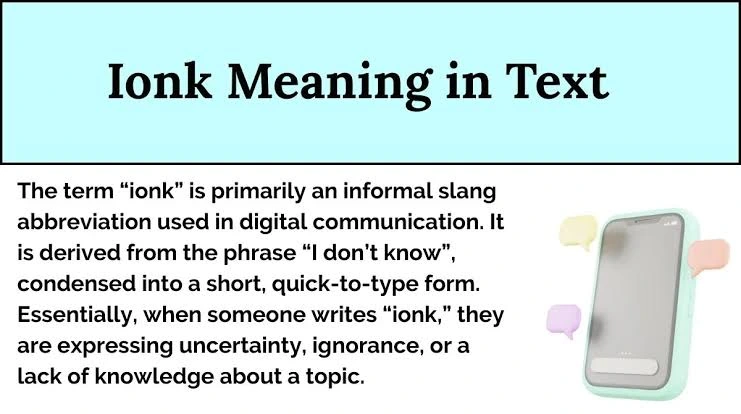
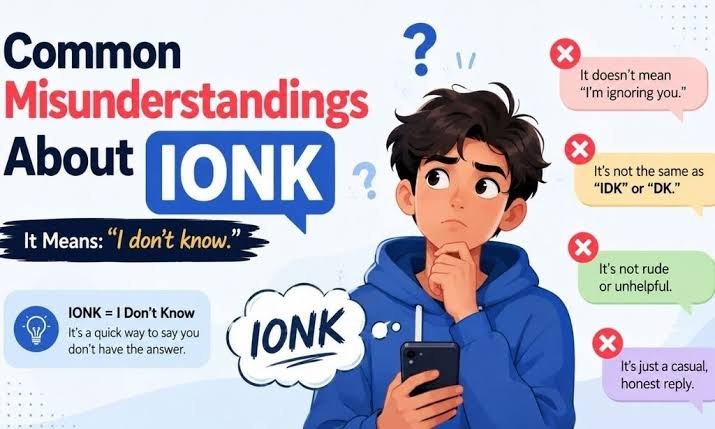
When it comes to Ionk Meaning In Text, the simple answer is that ionk usually means “I don’t know.” It is an informal, phonetic-style form used in casual digital conversations when someone does not have an answer, feels uncertain, or simply wants to give a quick response. The exact tone can change with context, though, so “ionk” may sometimes sound neutral, playful, hesitant, or slightly dismissive depending on the conversation.
Table of Contents
- What Does IONK Mean in Text?
- Quick Meaning of IONK
- Is IONK an Acronym or Slang?
- How Did IONK Develop?
- IONK Meaning in Different Contexts
- IONK in Text Messages
- IONK on Instagram
- IONK on TikTok
- IONK on Snapchat
- IONK in Group Chats
- IONK Meaning From a Girl
- IONK Meaning From a Guy
- Does IONK Have a Hidden Meaning?
- Is IONK Rude?
- IONK vs IDK
- IONK vs ION
- How to Use IONK in a Sentence
- Real-Life IONK Examples
- How to Reply to IONK
- When Not to Use IONK
- FAQs
- Final Thoughts
What Does IONK Mean in Text?
IONK usually means “I don’t know” in texting and online conversations. It is an informal slang form that people use when they are unsure about something, do not have enough information, or simply do not want to give a detailed answer. Unlike traditional abbreviations such as IDK, IONK looks more like a phonetic spelling of the way “I don’t know” can sound when spoken quickly.
For example, if someone asks, “Do you know when Sarah is coming?” and you reply, “ionk,” you are simply saying, “I don’t know.” The same expression can appear inside a longer sentence, such as “ionk what happened” or “ionk if I’m going tonight.” Current slang references and recent usage examples consistently describe IONK as a casual way to express uncertainty or lack of knowledge.
Simple Meaning
IONK = I don’t know
It can also communicate closely related ideas such as:
- I’m not sure
- I have no idea
- I don’t really know
- I don’t know honestly
- I’m uncertain
- I can’t say for sure
The exact wording changes, but the central idea remains the same: the person does not know or is unsure.
Quick Meaning of IONK
If you only need the answer quickly, here is the basic breakdown:
| Term | Meaning |
| IONK | I don’t know |
| Type | Internet/texting slang |
| Tone | Casual and informal |
| Common use | Texts, DMs, comments, group chats |
| Similar term | IDK |
| Formal? | No |
| Usually rude? | No, but tone can make it sound dismissive |
IONK is generally used in relaxed conversations rather than formal communication. You may encounter it in a private text, Instagram DM, Snapchat conversation, TikTok comment, gaming chat, or group conversation. Its meaning normally stays the same even when the platform changes; what changes is the tone created by the surrounding conversation.
For instance, “ionk 😂” may sound playful, while “ionk.” could feel much shorter or more dismissive if someone asked a serious question. The letters themselves do not necessarily carry that emotional difference. Context, punctuation, and the relationship between the people involved usually do.
Is IONK an Acronym or Slang?
IONK is better understood as informal internet slang or a phonetic-style spelling, rather than a conventional acronym. Traditional abbreviations such as IDK are formed from the first letters of words: “I Don’t Know.” IONK does not follow that same pattern neatly.
Instead, IONK appears to represent the way the phrase can be compressed in casual speech and texting. Similar online spellings such as “ion” are used as informal representations of “I don’t,” and IONK extends that casual sound-based style into “I don’t know.” Recent explanations of the term describe it as a phonetic or sound-based version rather than a strict initialism.
That distinction explains why IONK may look unusual at first. If you are expecting every abbreviation to follow the first-letter rule, the word can seem random. Once you understand that it is based on informal pronunciation and internet writing habits, its meaning becomes much easier to recognise.
How Did IONK Develop?
Internet slang rarely has one clearly documented inventor or launch date. Instead, expressions tend to develop gradually as people experiment with faster ways to communicate. IONK appears to fit this broader pattern of turning spoken language into short written forms.
A likely progression is “I don’t know” → “ion know” → “ionk.” The spelling reflects casual pronunciation rather than formal English grammar. Similar phonetic forms have become common online because people often type messages the way they speak rather than following traditional written rules.
There is evidence of IONK being used online for years, including user-generated slang records dating back to at least 2019. More recent slang guides continue to define it as a casual form of “I don’t know.” Because internet slang evolves organically, it is better to describe this development as a usage pattern rather than claim that one specific person created the term.
IONK Meaning in Different Contexts
Although Ionk Meaning In Text generally points to “I don’t know,” the emotional tone can change considerably depending on what the person is responding to. Someone may genuinely lack information, while another person may use IONK because they are undecided or do not want to explain themselves.
Genuine Uncertainty
If someone really does not know the answer, IONK is simply a quick way to say so.
Example:
“What time does the movie start?”
“ionk, maybe 8?”
Here, the sender is honestly uncertain.
Lack of Information
IONK can also mean that the person has not heard anything about a particular situation.
“Do you know why he left?”
“Ionk, he didn’t tell me.”
The sender is saying that they do not have the information.
Hesitation
Sometimes the sender knows part of the answer but is not confident enough to say it directly.
“Are they still together?”
“ionk honestly.”
This can mean something like, “I’m really not sure.”
Avoiding a Direct Answer
In some conversations, IONK can function as a soft way of avoiding a detailed response. That does not necessarily mean the person is being dishonest; they may simply not want to discuss the subject.
“Do you actually like him?”
“ionk 😭”
Here, the person may genuinely be unsure, jokingly avoiding the question, or simply not wanting to answer directly.
Playful Uncertainty
Emojis and surrounding words can make IONK playful rather than serious.
“Who told you that?”
“ionk 😂”
The sender may be joking or pretending not to know.
IONK in Text Messages
In ordinary texting, IONK works much like a quick replacement for “I don’t know.” It can stand alone as a complete reply or appear at the beginning of a longer sentence. Because texting is generally informal, people may not worry about capitalisation or punctuation.
You might see:
- ionk
- IONK
- Ionk
- ionk lol
- ionk honestly
- ionk bro
- ionk what happened
- ionk if that’s true
For example:
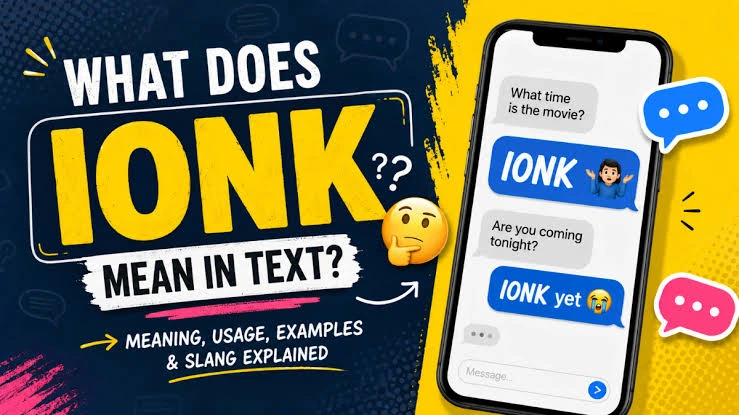
Person A: Are you coming tonight?
Person B: Ionk yet.
This means the person has not decided or does not know yet.
Another example:
Person A: Why is the app not working?
Person B: Ionk 😭
That simply communicates, “I don’t know,” possibly with a little frustration or humour.
IONK on Instagram
On Instagram, IONK can appear in DMs, Story replies, comments, and conversations around Reels. The platform encourages short, casual interactions, so slang like this can fit naturally into quick exchanges.
For example:
You: “Do you know when part two is coming?”
Friend: “ionk, waiting too 😭”
The meaning is straightforward: “I don’t know, I’m waiting too.”
You may also see IONK in comments where someone is responding to another user’s question:
Comment: “Is this actually real?”
Reply: “IONK 😂”
In this situation, the reply communicates uncertainty, but the laughing emoji makes it feel lighter and more playful.
IONK on TikTok
TikTok is one of the places where internet slang spreads quickly because users communicate through comments, captions, replies, livestreams, and DMs. IONK can be used when someone does not know an answer or wants to give a deliberately casual reaction.
For example:
Viewer: “Is this challenge still trending?”
Reply: “ionk but everyone is doing it.”
Here, the person is uncertain but provides additional information.
Another example might be:
Comment: “Why did he do that?”
Reply: “IONK 😭”
The sender may simply be saying, “I have no idea,” while using the emoji to make the response more expressive.
IONK on Snapchat
Snapchat is built around quick, informal communication, which makes short slang forms especially natural. Someone may use IONK in a direct chat or as a response to a snap when they do not know what is happening.
For example:
Friend: “Are you going to the party?”
You: “ionk yet.”
This means you have not decided.
Or:
Friend: “Why did she delete her story?”
You: “Ionk.”
That means you do not know why.
The abbreviation does not become a completely different word on Snapchat. The platform simply provides another casual environment where the term can be used.
IONK in Group Chats
Group chats often move quickly, and participants may not have time to write complete sentences. IONK can therefore work as a quick response when several people are discussing plans, rumours, events, or questions.
For example:
Alex: “Who is bringing snacks?”
Sam: “ionk.”
Mia: “I can bring some.”
Here, IONK is completely neutral.
However, a one-word answer can sometimes feel dismissive in a group conversation if someone is expecting help. For example:
Alex: “Does anyone know where the tickets are?”
Sam: “ionk.”
The meaning is still “I don’t know,” but the lack of additional help may make the response feel less engaged.
IONK Meaning From a Girl
If a girl sends you “ionk,” the basic meaning does not automatically change. Most of the time, she is simply saying “I don’t know” or “I’m not sure.” It is important not to assume that the word has a secret romantic meaning simply because it came from a girl.
For example:
You: “Do you know what time everyone is meeting?”
Her: “ionk, maybe around 7.”
She is clearly communicating uncertainty.
Relationship conversations can be more complicated:
You: “Do you actually want to go with me?”
Her: “ionk 😭”
This could indicate genuine uncertainty, hesitation, embarrassment, or a playful attempt to avoid giving a direct answer. You cannot determine which one from IONK alone. The rest of the conversation is what provides the useful clue.
IONK Meaning From a Guy
The same principle applies when a guy uses IONK. It generally means “I don’t know” and does not automatically indicate a particular emotional or romantic intention.
For example:
You: “Where did you leave the charger?”
Him: “ionk bro.”
That is simply a casual “I don’t know.”
In a relationship conversation:
You: “Do you think we should try again?”
Him: “Ionk honestly.”
This sounds more uncertain because of the word “honestly” and the seriousness of the question. Still, you would need to consider the broader conversation before deciding whether he is confused, hesitant, avoiding the question, or genuinely unsure.
Does IONK Have a Hidden Meaning?
In normal texting slang, IONK does not have a widely established secret meaning beyond “I don’t know.” Some websites may invent alternative expansions by assigning words to the letters, but those should not automatically be treated as established slang.
The most consistent current usage is the casual “I don’t know” meaning. Recent slang references, examples, and user-generated records all point toward that interpretation.
If someone sends you IONK in a conversation, the safest approach is therefore to read the surrounding message rather than search for a hidden romantic, negative, or coded definition. Context can change the tone, but it generally does not change the basic meaning.
Is IONK Rude?
IONK is not inherently rude. It is simply informal slang for “I don’t know.” However, a very short response can sometimes sound dismissive depending on the situation.
Compare these two examples:
“Ionk 😂 I have no idea.”
and
“ionk.”
The first feels more relaxed because it provides extra context and an emoji. The second could feel colder if the other person asked an important or serious question.
Tone also depends on your relationship. Among close friends, a one-word IONK may be completely normal. In a serious conversation, however, saying “I’m not sure” or explaining what you do know may come across as more considerate.
IONK vs IDK
IONK and IDK generally communicate the same basic idea: “I don’t know.” The main difference is how they are formed and how they feel stylistically.
| Term | Meaning | Style |
| IONK | I don’t know | Phonetic/informal |
| IDK | I don’t know | Initialism/casual |
| I’m not sure | I am uncertain | Neutral |
| I have no idea | I do not know | Casual/clear |
IDK is much more widely recognised because it is a conventional initialism. IONK feels more like a sound-based internet spelling and may be unfamiliar to people who have not encountered it online. Both can serve the same function in casual messages.
If you are talking to someone who may not recognise IONK, IDK or the complete phrase “I don’t know” will usually be clearer.
IONK vs ION
ION and IONK are related but not identical.
ION is commonly used in informal online speech as a shortened form of “I don’t.” It can be followed by another word:
- ion care = I don’t care
- ion want that = I don’t want that
- ion think so = I don’t think so
IONK, on the other hand, is used as a compact way to communicate “I don’t know.”
So, while the two forms share the same casual “I don’t” foundation, IONK can stand alone as a complete response.
How to Use IONK in a Sentence
Using IONK is simple because you can generally place it wherever “I don’t know” would naturally fit in an informal conversation.
At the Beginning
“Ionk what she wants.”
Meaning: I don’t know what she wants.
As a Complete Reply
“Who told him?”
“Ionk.”
Meaning: I don’t know.
With Another Casual Word
“Ionk bro, ask him.”
Meaning: I don’t know; ask him.
With an Emoji
“Ionk 😭”
This can make the message feel more playful, dramatic, or casual.
For Uncertainty
“Ionk if I’m going tonight.”
Meaning: I don’t know if I’m going tonight.
Because IONK is informal slang, it is best suited to texts, DMs, comments, and conversations with friends rather than formal writing.
Real-Life IONK Examples
Seeing IONK inside realistic conversations makes its meaning much easier to understand.
Example 1: Making Plans
Friend: Are you coming with us tonight?
You: Ionk yet.
Meaning: I don’t know yet.
Example 2: Asking About Someone
You: Why is Emma not answering?
Friend: Ionk, maybe she’s busy.
Meaning: I don’t know.
Example 3: Funny Situation
You: Who ate all the cake?
Friend: Ionk 😂
Meaning: I don’t know, or a playful “I have no idea.”
Example 4: Social Media
You: Is that video real?
Friend: IONK 😭
Meaning: I don’t know if it’s real.
Example 5: Relationship Question
You: Do you think he likes her?
Friend: Ionk honestly.
Meaning: I’m not sure.
Example 6: Group Chat
Person A: Who is bringing the drinks?
Person B: Ionk.
Person C: I’ll bring them.
Meaning: Person B does not know.
Example 7: Avoiding a Detailed Answer
You: So are you going to tell me what happened?
Friend: Ionk 😭
Meaning: I don’t know, or possibly a playful/hesitant refusal to explain.
Example 8: TikTok Comment
Commenter: Why did he do that?
Reply: ionk 😂
Meaning: I have no idea.
How to Reply to IONK
Your best response depends on why the person used IONK. If they genuinely do not know something, there is usually no need to make the conversation complicated. You can simply provide more information, ask another question, or move on.
Simple Replies
- No worries.
- Okay, thanks.
- That’s alright.
- Got it.
- Fair enough.
If You Need an Answer
- Can you find out?
- Who would know?
- Let me know when you find out.
- Can you check?
- Do you have any idea?
Playful Replies
- Very helpful 😂
- Thanks for nothing 😭
- Mystery remains unsolved.
- You know more than you’re saying 😂
- That’s not the answer I wanted!
If You Think They Are Avoiding the Question
Instead of immediately assuming they are ignoring you, ask naturally:
- “You really don’t know?”
- “Are you sure? 😂”
- “You don’t want to tell me, do you?”
- “Okay, but seriously?”
This gives the other person an opportunity to clarify without turning a short slang response into an unnecessary misunderstanding.
When Not to Use IONK
IONK is designed for casual communication, so it should generally stay in casual spaces. It may be perfectly normal in a group chat with friends but inappropriate in a professional email or formal message.
Avoid using IONK in:
- Job applications
- Business emails
- Academic assignments
- Professional presentations
- Formal reports
- Customer-service messages
- Official workplace communication
Instead, use clearer alternatives such as “I don’t know,” “I’m not sure,” “I don’t have that information,” or “I’ll check and let you know.” These phrases communicate the same uncertainty while sounding professional and respectful.
The goal is not to stop using slang altogether. It is simply to match your language to your audience. Knowing when a slang term fits is as important as knowing what it means.
Final Thoughts
Understanding Ionk Meaning In Text is much easier once you recognise that it is an informal, sound-based form of “I don’t know.” Unlike traditional abbreviations such as IDK, IONK does not follow a strict first-letter formula. Instead, it reflects the way casual speech can be shortened and represented in online writing.
Most of the time, there is no complicated hidden message behind it. Someone using IONK is simply saying that they do not know, are unsure, or do not have enough information to answer. Still, the tone can shift depending on the conversation. A laughing emoji can make it playful, while a one-word response to a serious question can feel dismissive. When in doubt, focus on the complete conversation rather than trying to interpret four letters on their own.
FAQs
What does IONK mean in text?
IONK usually means “I don’t know.” It is informal internet slang used in texts, DMs, comments, and casual online conversations to express uncertainty or a lack of information.
Is IONK the same as IDK?
Yes, in most casual conversations, they communicate the same basic idea: “I don’t know.” IDK is a traditional initialism, while IONK is more of a phonetic-style slang spelling.
What does IONK mean on TikTok?
On TikTok, IONK usually means “I don’t know.” It can appear in comments, replies, captions, and DMs when someone is uncertain or wants a quick, casual response.
What does IONK mean on Instagram?
IONK on Instagram generally means “I don’t know.” You may see it in DMs, Story replies, comments, or conversations about Reels.
What does IONK mean on Snapchat?
On Snapchat, IONK is normally used as a quick, casual way to say “I don’t know.” The fast nature of Snapchat conversations makes short slang forms especially suitable.
What does IONK mean from a girl?
If a girl says IONK, it generally means “I don’t know” or “I’m not sure.” If she uses it during a personal or relationship conversation, the tone may indicate hesitation, but you need the surrounding conversation to understand her intention.
What does IONK mean from a guy?
A guy using IONK is usually just saying “I don’t know.” It does not automatically mean he is annoyed, flirting, or avoiding you. The context determines whether the response is neutral, playful, or hesitant.
Is IONK rude?
IONK is not inherently rude, but a very short reply can sometimes sound dismissive. In a serious conversation, writing “I’m not sure” or giving a little more explanation can sound more thoughtful.
Is IONK a real word?
IONK is not standard English. It is informal internet slang used in digital communication. It is better treated as texting language rather than something appropriate for formal writing.
Is IONK an acronym?
Not in the traditional sense. IONK is generally described as a phonetic or sound-based slang form of “I don’t know,” rather than an initialism where each letter represents a separate word.
What does ION mean in texting?
ION commonly represents “I don’t” in informal online slang. It can appear in expressions such as “ion care” or “ion think so.” IONK extends this style into “I don’t know.”
Can I use IONK in formal writing?
No. IONK is informal slang and is best avoided in academic, professional, or official communication. Use “I don’t know,” “I’m not sure,” or another complete phrase instead.
Does IONK always mean “I don’t know”?
In current texting usage, that is the dominant meaning. The emotional tone may vary between uncertainty, hesitation, humor, or mild avoidance, but the underlying idea is generally “I don’t know.”
Can IONK sound dismissive?
Yes, depending on how it is used. A standalone “ionk” can feel abrupt if someone has asked an important question. Adding context, such as “ionk, I’ll check,” makes the response sound more helpful.
What is the easiest way to remember IONK?
Simply remember:
IONK = I don’t know
If you see it in a casual message, start with that meaning and then use the surrounding conversation to determine whether the sender sounds serious, uncertain, playful, or dismissive.