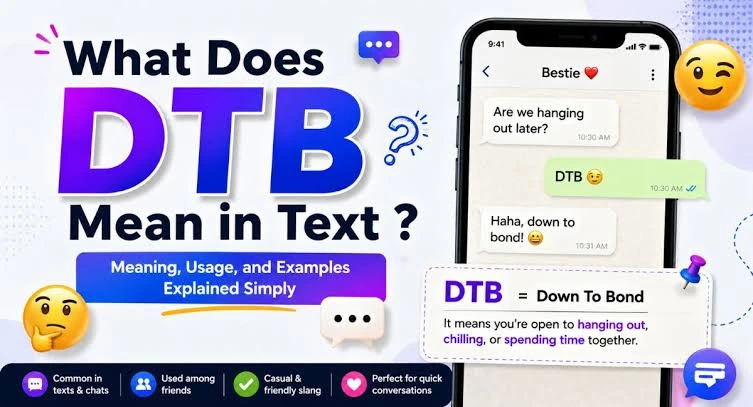

Have you ever received a message ending with DTB and wondered whether you were supposed to reply? Texting abbreviations can be confusing because the same three letters may have different meanings depending on the conversation, platform, and people involved. If you are searching for DTB Mean In Text, the most common meaning in ordinary texting is Don’t Text Back.
People typically use DTB when they do not need or want a response to their message. Someone might send it because they are going to sleep, getting busy, leaving their phone, or simply ending the conversation for the moment. However, DTB can also have another slang meaning in social media, music, and relationship-related contexts, so understanding the surrounding conversation is important.
What Does DTB Mean In Text?
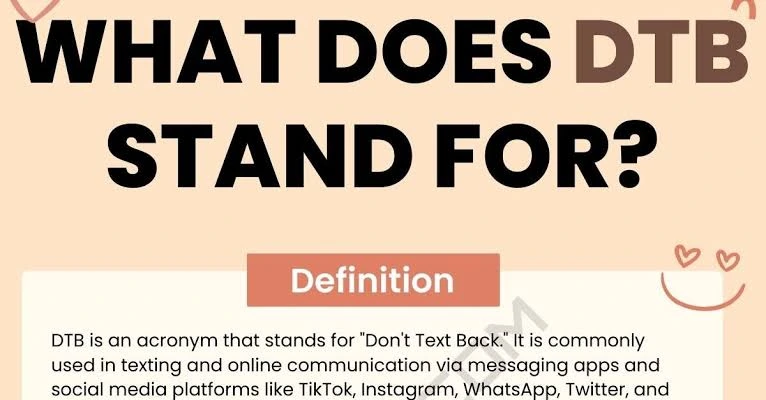
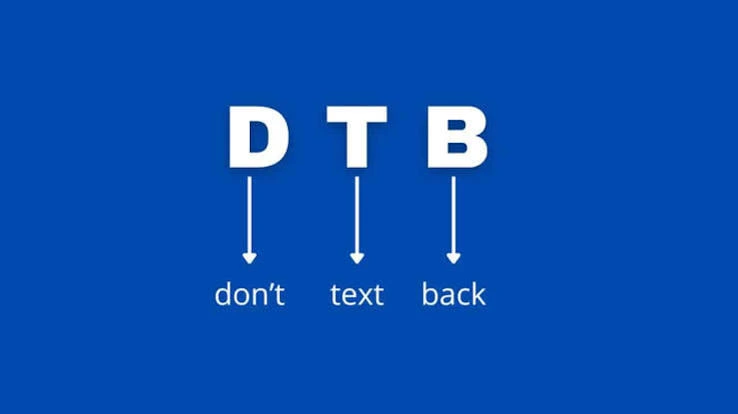
The most common DTB Mean In Text is Don’t Text Back. It is an informal abbreviation used to tell someone that they do not need to respond to the message. Instead of writing the complete phrase, people shorten it to three letters because texting is usually quick and casual.
For example, someone might write, I’m going to sleep now, DTB 😴. In this situation, DTB means there is no need to reply because the sender is ending the conversation. The abbreviation is particularly useful when someone wants to communicate quickly without leaving the other person wondering whether a response is expected.
Quick Meaning
- DTB = Don’t Text Back
- It usually means a reply is not needed
- It is mainly used in casual communication
- The tone can be friendly, neutral, or blunt
- Context determines the exact meaning
- DTB is not normally suitable for formal communication
So, if someone sends you DTB during an ordinary conversation, the safest first interpretation is Don’t Text Back.
What Does DTB Stand For?
DTB most commonly stands for Don’t Text Back when it appears in regular text messages. It is an example of internet shorthand, where a longer phrase is reduced to its first letters to make communication faster.
The expression can be useful when someone wants to share information without starting another conversation. For example, a person might tell a friend that they have arrived somewhere and add DTB to indicate that the friend does not need to respond.
The important thing about DTB Mean In Text is that it is not normally a request for a response. In fact, it communicates the opposite: the sender is telling you that replying is unnecessary.
Why Do People Use DTB?
People use DTB mainly because texting encourages short, fast communication. Typing three letters takes less effort than writing Don’t Text Back, particularly when someone is busy or about to put their phone away.
Another reason is convenience. If a person sends a quick update, they may not want to create an expectation that the recipient should answer. Adding DTB removes some of that pressure.
People may use DTB when they are:
- Going to sleep
- Going offline
- Busy at work
- Entering a meeting
- Driving or travelling
- Ending a conversation
- Sending a quick update
- Making a casual joke
This makes DTB Mean In Text fairly straightforward when it appears at the end of an ordinary message.
DTB Examples in Text Messages
The easiest way to understand DTB Mean In Text is to see how people might naturally use it. The same abbreviation can sound slightly different depending on the message around it.
Example 1: Going to Sleep
A: I’m exhausted, going to sleep now. DTB 😴
B: Goodnight!
Here, DTB simply means Don’t Text Back. The sender is letting the other person know that they are finished chatting for the night.
Example 2: Going Offline
A: My battery is almost dead, DTB.
B: Okay, talk later.
The sender does not expect an immediate response because they are about to lose access to their phone.
Example 3: At Work
A: I’m in a meeting for an hour, DTB.
B: Got it.
This usage is direct and practical. The sender is explaining that they are unavailable.
Example 4: Casual Update
A: Made it home safely, DTB.
B: 👍
The message is simply an update rather than an invitation to continue chatting.
Example 5: Playful Use
A: I’m about to watch the finale. DTB 😂
B: Fine, I won’t spoil it.
Here, DTB is used casually and humorously.
What Does DTB Mean on Snapchat?
On Snapchat, DTB Mean In Text is usually understood as Don’t Text Back when it appears in an ordinary conversation. Someone might add DTB to a message because they are going to sleep, leaving Snapchat, or simply do not need a reply.
Snapchat conversations are generally informal, so abbreviations like DTB fit naturally into quick chats. The meaning can also depend on whether DTB appears in a private message, caption, or other social context.
For example:
Going offline now DTB 👋
This simply means the person is leaving and does not expect a response.
However, if DTB appears in a relationship-related caption or a trend-based post, the meaning may be different. Always look at the surrounding content before deciding what the sender means.
What Does DTB Mean on Instagram?
Instagram users may use DTB in DMs, captions, comments, and Stories. In a normal DM, DTB Mean In Text is most likely Don’t Text Back when someone is ending a conversation or saying that a reply is unnecessary.
For example:
I have to go study now DTB.
The sender is simply closing the conversation.
Instagram also has a large slang and trend culture, so DTB can sometimes appear with a different meaning in relationship posts or music-related content. That is why the context is especially important on Instagram.
If DTB appears alongside phrases about dating, betrayal, or distrust, it may not mean Don’t Text Back at all.
What Does DTB Mean on TikTok?
TikTok is one of the platforms where DTB can have multiple meanings. In ordinary texting, it can still mean Don’t Text Back, but social-media slang may use DTB to express distrust toward romantic partners or other people.
The competitor page notes Don’t Trust B*tches as another slang interpretation, while other sources also document Don’t Trust Boys as a social-media variation.
For example, if you see DTB underneath a breakup-related TikTok, the intended meaning may be about distrust rather than replying to a message. If you see DTB at the end of a private chat, Don’t Text Back is usually the more natural interpretation.
This is why the platform and surrounding content matter when understanding DTB Mean In Text.
Another Meaning of DTB: Don’t Trust Bitches
One important alternative to DTB Mean In Text is Don’t Trust Bitches, a strongly informal and potentially offensive phrase. This meaning is more likely to appear in certain social-media, music, meme, and relationship-related communities.
It is often connected with themes such as betrayal, heartbreak, cheating, or distrust. Because the wording is offensive to some people, it should not be treated as a neutral everyday abbreviation.
You may see this version in:
- Relationship posts
- Breakup content
- Rap and hip-hop culture
- Memes
- TikTok captions
- Social-media discussions about distrust
If DTB appears in this type of context, Don’t Text Back may not be the intended meaning.
DTB Can Also Mean Don’t Trust Boys
Another social-media interpretation is Don’t Trust Boys. This version is commonly associated with relationship and dating content, particularly posts about disappointment or bad experiences.
For example, someone might post:
New rule: DTB.
If the surrounding post discusses dating problems, the intended meaning could be Don’t Trust Boys rather than Don’t Text Back.
This is a good example of why DTB Mean In Text cannot always be determined from the three letters alone. The same abbreviation can communicate completely different ideas depending on where and how it appears.
How to Know Which DTB Meaning Is Correct
Context is the most reliable way to understand DTB Mean In Text. Start by looking at the sentence containing DTB, then consider your relationship with the sender and the platform where you saw it.
If someone says Going to sleep, DTB, the meaning is almost certainly Don’t Text Back. If someone posts DTB with a breakup quote or a relationship-related video, a distrust-related meaning may be more likely.
Look at These Clues:
- Is it a private text or public post?
- Is the person ending a conversation?
- Are they talking about dating?
- Is the message connected to music or memes?
- Does the surrounding text mention betrayal?
- Is DTB placed at the end of a normal update?
The more context you have, the easier it becomes to identify the intended meaning.
Is DTB Rude?
DTB is not automatically rude, but it can sound blunt depending on how it is used. A friendly message such as Going to sleep, DTB 😴 sounds harmless because the sender explains the situation and uses a soft tone.
On the other hand, sending only DTB in the middle of an emotional conversation may feel dismissive. The recipient might interpret it as stop messaging me rather than simply I do not need a response right now.
Tone is therefore extremely important.
Friendly
I’m heading to bed now, DTB 😴
This sounds relaxed.
Neutral
At work, DTB.
This is direct but understandable.
Cold
DTB.
Without context, this may feel abrupt.
A little explanation can make the message much easier to understand.
Is DTB a Positive or Negative Expression?
There is no single emotional tone attached to DTB. When it means Don’t Text Back, it can be completely neutral. Someone may use it simply because they are busy or going offline.
The alternative distrust-related meanings are more negative because they usually express disappointment, suspicion, or frustration. Therefore, the emotional meaning depends heavily on which definition is being used.
If you receive DTB from a friend before they go to sleep, there is probably nothing negative behind it. If you see DTB in a breakup post, the emotional meaning may be very different.
Can DTB Be Used in Professional Communication?
It is better to avoid DTB in professional communication. Even when you intend Don’t Text Back, the abbreviation may be unclear to someone who is unfamiliar with texting slang.
Instead, write the complete phrase or use a clearer sentence.
Informal:
I’m busy right now, DTB.
Professional:
I’m currently in a meeting, so there is no need to reply.
Another Clear Option:
I’ll contact you later. No response is necessary for now.
Using complete wording avoids confusion and keeps professional communication clear.
When Should You Use DTB?
If you are talking with friends or people who regularly use texting slang, DTB can be perfectly natural. It is especially useful when you want to end a conversation without creating pressure for the other person to respond.
You can use DTB when:
- You are going to sleep
- You are heading offline
- You are temporarily unavailable
- You are sending a simple update
- You are ending a casual conversation
- You are joking with a close friend
The key is to use it with people who understand informal texting language.
When Should You Avoid DTB?
Avoid DTB when clarity and professionalism are important. If there is a chance the recipient will not understand the abbreviation, the full phrase is much better.
Avoid it in:
- Business emails
- Job applications
- School assignments
- Official messages
- Client communication
- Important workplace conversations
- Formal customer service communication
In these situations, abbreviations can create unnecessary confusion.
DTB vs TTYL
TTYL means Talk To You Later. It is another common way to end a casual conversation, but it does not have the same meaning as DTB.
DTB tells the other person that they do not need to reply. TTYL suggests that the conversation will continue later.
For example:
DTB: I’m going to sleep now, DTB.
TTYL: I have to go now, TTYL.
The first specifically says that no reply is necessary, while the second suggests another conversation later.
DTB vs BRB
BRB means Be Right Back. It tells someone that you are temporarily leaving but expect to return.
DTB has a different purpose because it tells the recipient not to reply.
BRB:
BRB, grabbing some water.
Meaning: I will return soon.
DTB:
Going to sleep, DTB.
Meaning: Do not reply.
Knowing these differences makes texting abbreviations much easier to understand.
DTB vs GTG
GTG means Got To Go or Gotta Go. It is used when someone needs to leave a conversation.
DTB can sometimes appear in the same type of situation, but the two abbreviations communicate different information.
GTG focuses on the sender leaving.
DTB focuses on the recipient not needing to reply.
For example:
GTG: Talk tomorrow.
This says the sender has to leave.
Going to sleep, DTB.
This says the sender is leaving and does not expect a response.
How to Respond to DTB
If someone uses DTB to mean Don’t Text Back, you usually do not need to respond at all. That is actually the point of the abbreviation.
However, if you have already received the message and want to acknowledge it, a reaction or very short response may be appropriate depending on the relationship.
You could use:
- 👍
- Okay
- Got it
- Goodnight
- Take care
If the sender clearly says DTB, respecting their request and not continuing the conversation is usually the best choice.
What Does DTB Mean From a Girl?
If a girl sends DTB in an ordinary conversation, it usually means Don’t Text Back. She may be going to sleep, becoming busy, or simply ending the conversation temporarily.
Do not automatically assume that she is angry or upset. The surrounding message is more important than the abbreviation.
For example:
I have class now, DTB.
This is simply an indication that she cannot continue chatting.
However, if DTB appears after an argument or alongside relationship-related content, it could carry a more negative or dismissive tone.
What Does DTB Mean From a Guy?
The same basic rule applies when a guy sends DTB. In a normal conversation, it most likely means Don’t Text Back.
For example:
Heading to work, DTB.
There is no obvious negative meaning here. The sender is simply saying that they will be unavailable.
If the message is part of a disagreement, however, DTB could sound more direct or cold. Context determines whether the abbreviation feels casual or dismissive.
What Does DTB Mean in a Relationship?
In relationships, DTB can have two very different meanings. During a normal conversation, it can simply mean Don’t Text Back. For example, one partner might say they are going to sleep and do not need a reply.
In relationship-focused social-media content, DTB may instead express distrust. This usage is associated with phrases such as Don’t Trust Boys or the more offensive Don’t Trust Bitches.
Therefore, if you see DTB in a relationship post, look at the rest of the caption before interpreting it.
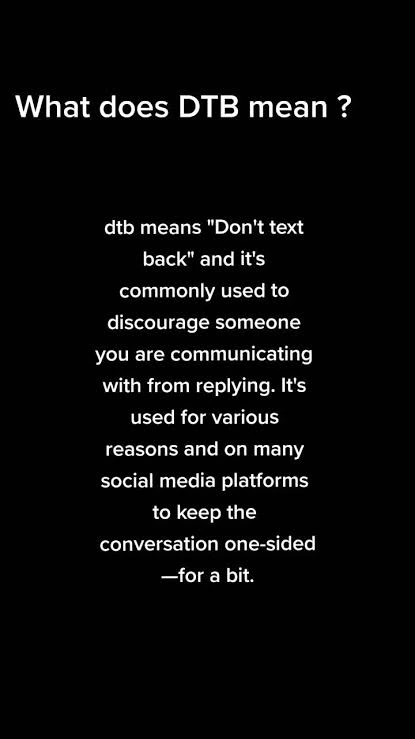
Does DTB Always Mean Don’t Text Back?
No. Don’t Text Back is the most common meaning in ordinary texting, but DTB can have other meanings in social-media and cultural contexts.
The most useful interpretations to remember are:
| Context | Possible Meaning |
| Regular texting | Don’t Text Back |
| Casual chat | Don’t Text Back |
| Snapchat message | Don’t Text Back |
| Instagram DM | Usually Don’t Text Back |
| Relationship post | Don’t Trust Boys or another distrust-related phrase |
| Music or meme context | May refer to a distrust-related meaning |
Context should always come before assumptions.
Common Mistakes When Understanding DTB
One common mistake is assuming that every DTB has the same meaning. Slang develops differently across communities, and social-media platforms can give abbreviations additional meanings.
Another mistake is assuming that DTB is always rude. A person may use it simply to explain that they are unavailable. Likewise, assuming it is always harmless can be incorrect if it appears in a relationship-related post using a distrust-based meaning.
A third mistake is using DTB in formal communication. Even if you understand it perfectly, the other person may not, which can make your message look unclear or overly casual.
Why Context Matters With Texting Slang
Texting abbreviations often depend on context more than traditional vocabulary does. A word usually has a stable dictionary definition, but an abbreviation can develop several meanings across different online communities.
That is especially true for DTB Mean In Text. A three-letter abbreviation at the end of a sleep message has a very different purpose from the same three letters in a breakup-related TikTok caption.
When you are unsure, read the complete message rather than focusing only on DTB. Look at the platform, topic, relationship, punctuation, emojis, and words surrounding the abbreviation.
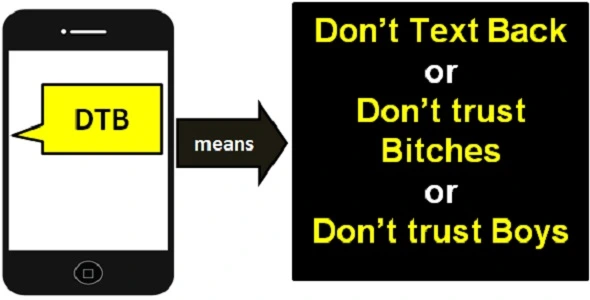
Quick Guide to DTB Meanings
If you want the shortest possible explanation, remember these points:
- DTB most commonly means Don’t Text Back
- It can tell someone that a reply is unnecessary
- It is mainly used in informal conversations
- It may sound friendly, neutral, or blunt
- Social media can give DTB other meanings
- Relationship content may use DTB for distrust
- Formal communication should avoid the abbreviation
- Context is the best way to identify the intended meaning
Once you understand these distinctions, seeing DTB in a message becomes much less confusing.
Final Thoughts
The most common DTB Mean In Text is Don’t Text Back, a simple informal way of telling someone that they do not need to reply. People often use it when they are going to sleep, heading offline, becoming busy, or ending a casual conversation. In ordinary texting, it is usually neutral rather than negative.
However, DTB can also appear with different meanings on TikTok, Instagram, in music-related content, and in relationship discussions. Depending on the context, it may refer to a distrust-related phrase such as Don’t Trust Boys or another informal variation. That is why the surrounding message matters more than the abbreviation by itself.
If you remember one rule, make it this: check the context before interpreting DTB. A simple message such as Going to bed, DTB clearly points to Don’t Text Back, while a relationship-focused post may indicate a completely different meaning.
FAQs
What does DTB mean in text?
DTB most commonly means Don’t Text Back. It tells the recipient that they do not need to respond to the message.
What does DTB stand for?
In ordinary texting, DTB stands for Don’t Text Back. It is an informal abbreviation used mainly in casual digital communication.
Is DTB rude?
DTB is not automatically rude. It can sound friendly when someone uses it to say they are going to sleep or becoming busy, but a bare DTB can sometimes sound cold or dismissive.
What does DTB mean on Snapchat?
On Snapchat, DTB usually means Don’t Text Back when used in an ordinary private conversation. The meaning can change if it appears in a trend, caption, or relationship-related post.
What does DTB mean on Instagram?
On Instagram, DTB commonly means Don’t Text Back in casual DMs. In relationship-related captions, however, it may have a distrust-related meaning.
What does DTB mean on TikTok?
DTB can mean Don’t Text Back in ordinary messaging, but TikTok content may also use it as a distrust-related abbreviation. The surrounding video, caption, and comments can help identify the intended meaning.
Does DTB mean Don’t Text Back?
Yes. Don’t Text Back is the most common meaning of DTB in regular texting.
Does DTB have another meaning?
Yes. In some social-media and music-related contexts, DTB can refer to a distrust-related phrase such as Don’t Trust Bitches or Don’t Trust Boys.
What does DTB mean in relationships?
In an ordinary relationship conversation, DTB can mean Don’t Text Back. In relationship-related social-media content, it can also express distrust toward romantic partners.
What does DTB mean from a girl?
If a girl sends DTB in a normal chat, it usually means Don’t Text Back. The reason she uses it could be that she is busy, going to sleep, or ending the conversation.
What does DTB mean from a guy?
If a guy sends DTB in a normal text, it usually means Don’t Text Back. The tone depends on the message around it.
Is DTB a slang word?
DTB is an informal abbreviation or texting initialism rather than a standard formal English expression. It is mainly used in casual online communication.
Can I use DTB at work?
It is better to avoid DTB at work, especially in formal emails or communication with clients. Use a clear phrase such as No need to reply instead.
What should I reply to DTB?
If DTB means Don’t Text Back, you generally do not need to reply. If you want to acknowledge the message, a simple reaction or brief response may be enough.
What is the difference between DTB and TTYL?
DTB means Don’t Text Back, while TTYL means Talk To You Later. DTB says a response is not necessary, whereas TTYL suggests the conversation will continue later.
What is the difference between DTB and BRB?
BRB means Be Right Back, indicating that someone will return soon. DTB means Don’t Text Back, indicating that the recipient does not need to respond.
What is the difference between DTB and GTG?
GTG means Got To Go or Gotta Go. It tells someone that the sender needs to leave, while DTB specifically tells the recipient that a response is unnecessary.
Does DTB always have a negative meaning?
No. When DTB means Don’t Text Back, it can be completely neutral. A negative tone is more likely when it is used in an argument or with a distrust-related social-media meaning.
Why do people use DTB instead of writing Don’t Text Back?
People use DTB because it is shorter and faster to type. It also fits the informal style of texting and social-media communication.
How do I know which DTB meaning someone intends?
Look at the complete message, platform, surrounding words, relationship between the people, and overall tone. A sleep or busy message usually indicates Don’t Text Back, while relationship-related content may indicate a distrust-based meaning.
Is DTB appropriate for formal writing?
No. DTB is informal slang and is better suited to casual conversations. In professional or academic writing, use the complete phrase or a clearer sentence.
Can DTB mean Don’t Trust Boys?
Yes. Don’t Trust Boys is used as a social-media slang interpretation of DTB, particularly in relationship and dating-related content. It is different from the everyday texting meaning Don’t Text Back.
Can DTB mean Don’t Trust Bitches?
Yes. This is another documented slang interpretation, particularly in some social-media and music-related contexts. Because the phrase contains offensive language, it is not appropriate for polite or professional communication.
Is DTB commonly used in texting?
Yes. Don’t Text Back is a recognised informal texting use of DTB. It is particularly useful when someone wants to end a conversation or explain that they do not need a response.
What does DTB mean when someone says “going to sleep DTB”?
In this context, DTB almost certainly means Don’t Text Back. The sender is saying they are going to sleep and do not expect a reply.
What does DTB mean when someone says “I’m busy DTB”?
It usually means Don’t Text Back. The sender is busy and does not want or need a response at that moment.
Can DTB sound dismissive?
Yes. A short message containing only DTB can sometimes feel dismissive, especially during an emotional conversation. Adding context can make the intended meaning clearer and softer.