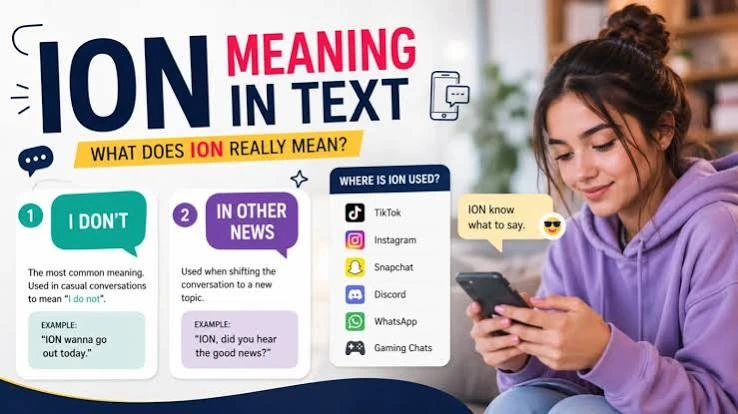

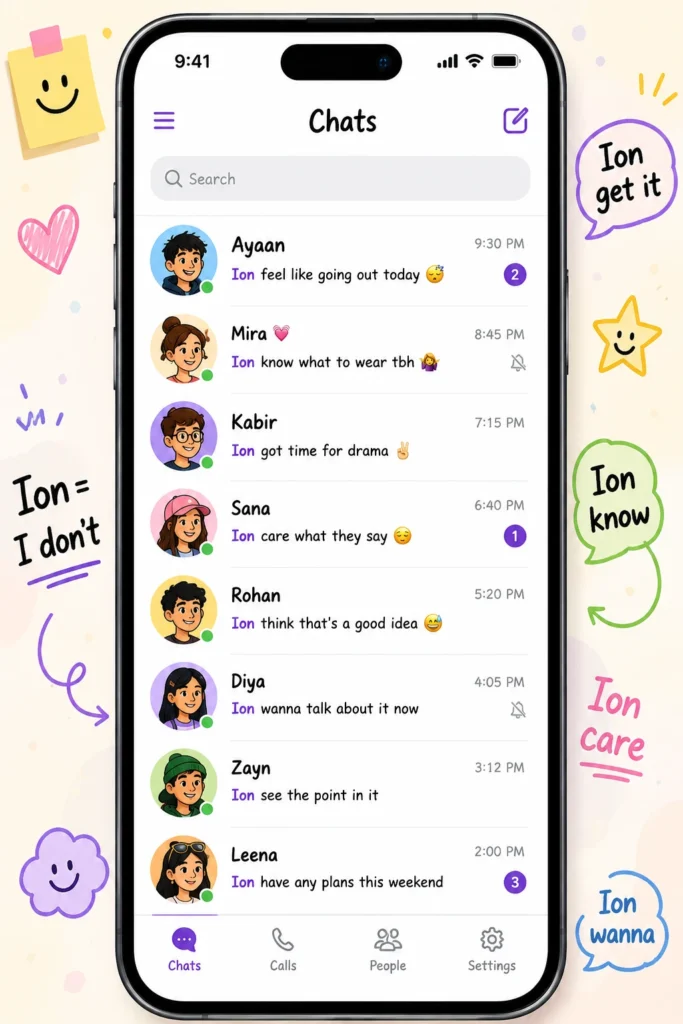
A friend sends you a message that says, “Ion think that’s a good idea.” You pause for a second. Is “Ion” someone’s name? Is it a typo? Or does it mean something completely different?
If you’ve had that reaction, you’re in good company. Thousands of people search for the meaning of Ion because it doesn’t look like a typical internet abbreviation. Unlike LOL or BRB, it isn’t made up of the first letters of several words. Instead, it’s written the way many people naturally pronounce a common phrase during casual conversations.
That’s also why Ion can be confusing. Depending on where you see it, the word can have more than one meaning. In chemistry, an ion is a charged atom or molecule. But if you’re reading a text message, scrolling through TikTok comments, or chatting on Snapchat, that’s almost certainly not what the sender is talking about.
This guide explains the verified meaning of Ion in texting, where the expression came from, how people use it on different social media platforms, and why understanding the context is more important than focusing on the word itself.
[Insert Image 1 Here]
Alt Text: Person looking at a smartphone message containing the word “Ion” while trying to understand its meaning in a casual text conversation.
What Does Ion Mean in Text?
Featured Snippet
In texting and social media, Ion most commonly means “I don’t.” Instead of typing the full phrase, some people write Ion because it reflects how the words are often pronounced in fast, informal speech. It’s widely seen in casual conversations across platforms like TikTok, Snapchat, Instagram, X, and text messages.
For example:
Ion know what happened.
This simply means:
I don’t know what happened.
Although the spelling is different, the intended meaning stays the same.
Why Do People Type “Ion” Instead of “I Don’t”?
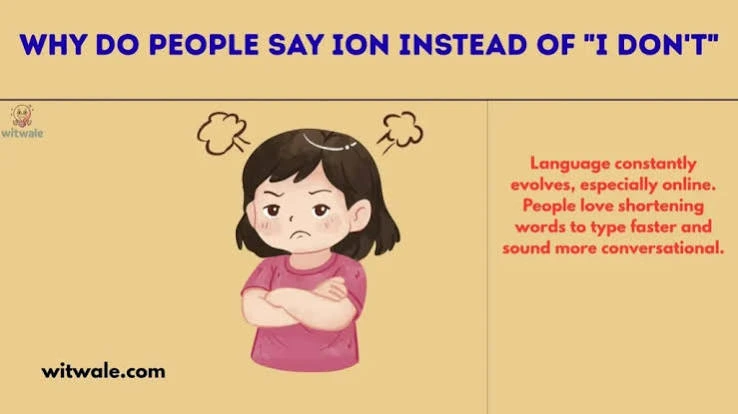
Language changes all the time, especially online. People naturally shorten words, combine sounds, and spell phrases the way they speak rather than the way they’re written.
That’s exactly what happened with Ion.
When someone quickly says “I don’t,” the words can blend in everyday speech. Online, many users began typing the phrase the same way it sounded to them, and over time, Ion became a familiar part of internet slang in many online communities.
It’s important to understand that this isn’t considered standard English. Instead, it’s an example of informal digital communication, where speed and conversational style often influence spelling.
Where Did Ion Come From?
Unlike abbreviations that were invented specifically for texting, Ion has roots in spoken language.
Linguists generally recognise its popularity as being influenced by African American Vernacular English (AAVE), where natural pronunciation patterns sometimes combine words in ways that differ from standard written English. As social media grew, many expressions from everyday speech spread across platforms such as Vine, Twitter (now X), TikTok, YouTube, and Instagram.
Today, millions of users who aren’t AAVE speakers also use Ion because they’ve become familiar with it through online conversations.
Understanding this background helps explain why Ion isn’t simply a random internet trend it reflects how language naturally evolves through communities and digital communication.
Is Ion Always an Abbreviation?
Not at all, and this is where context becomes essential.
If someone texts:
Ion want to go today.
they almost certainly mean:
I don’t want to go today.
However, if you’re reading a science textbook discussing atoms and electricity, ion refers to a completely different concept: a particle that carries an electrical charge.
Similarly, you might encounter ION as part of a company name, television network, product, or technology brand.
This is why reading the surrounding sentence is so important. The same four letters can represent different things depending on where they appear.
Real Texting Examples of Ion
Looking at actual conversations makes the meaning much easier to understand.
Example 1
Person 1:Are you coming tonight?
Person 2: Ion think I can.
Meaning:
I don’t think I can.
Example 2
Person 1: Did you finish the assignment?
Person 2: Ion even started yet.
Meaning:
I don’t even know where to begin.
Example 3
Friend: Did you hear the news?
You: Ion know what happened. Tell me.
Meaning:
I don’t know what happened. Tell me.
Notice that in every example, replacing Ion with I don’t creates a perfectly natural sentence.
Why Is Ion So Popular on Social Media?
One reason Ion has become so common is that it feels quick, conversational, and natural. Social media platforms encourage fast communication, and users often write the way they speak rather than following formal grammar rules.
Short expressions also help conversations feel more relaxed. Instead of carefully typing every word, many people prefer shorter forms that still communicate the same idea.
That’s why you’ll regularly see Ion in:
- TikTok comments
- Snapchat chats
- Instagram direct messages
- X posts
- Discord conversations
- Reddit discussions
- SMS text messages
Its popularity isn’t about saving huge amounts of time—it’s about matching the casual tone of online conversations.
Does Everyone Use Ion the Same Way?
Not necessarily.
Some people use Ion every day, while others never type it at all. Age, region, personal writing style, and the communities someone participates in can all influence whether they choose to use internet slang.
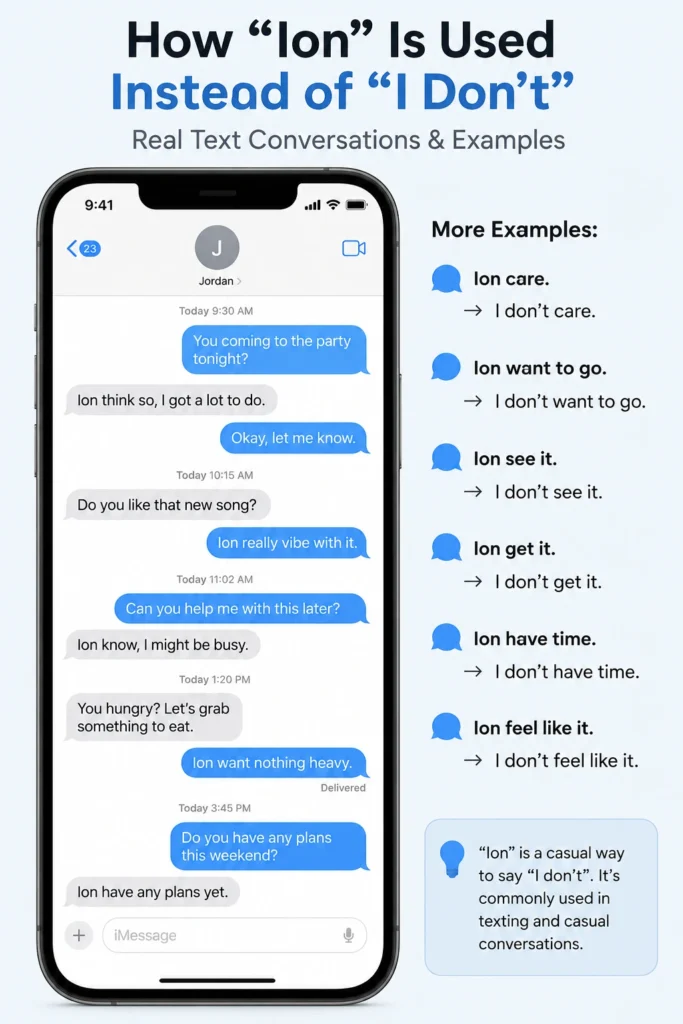
For example, close friends chatting on Snapchat may write:
Ion care 😂
The same person would probably write:
I don’t think that’s appropriate.
In a work email or university assignment.
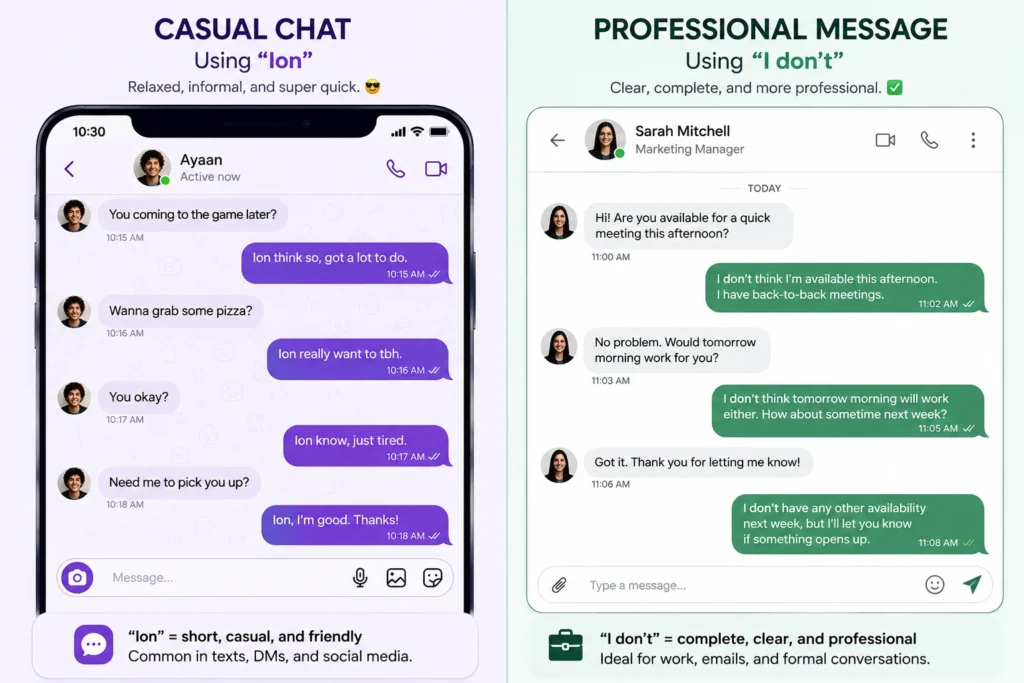
Knowing when to switch between informal and formal language is part of effective communication, both online and offline.
How Is Ion Used in Everyday Conversations?
The easiest way to understand Ion is to see it in real conversations. Unlike many abbreviations, it doesn’t replace an entire sentence it simply takes the place of the words “I don’t.”
Once you recognise that pattern, reading messages becomes much easier.
Example 1: Making Weekend Plans
Mia: Are you going to the concert on Friday?
Chris: Ion think I’ll make it. I have to work late.
Here, Ion simply means “I don’t.”
Example 2: Talking About Food
Ella: Do you like spicy food?
Noah: Ion eat spicy food very often.
The meaning becomes:
I don’t eat spicy food very often.
Example 3: Sharing an Opinion
Sophia: That movie was amazing.
Lucas: Ion agree, but the ending was good.
Again, replacing Ion with “I don’t” makes the sentence read naturally.
These examples show why context matters. The rest of the sentence almost always tells you exactly what the writer means.
[Insert Image 5 Here]
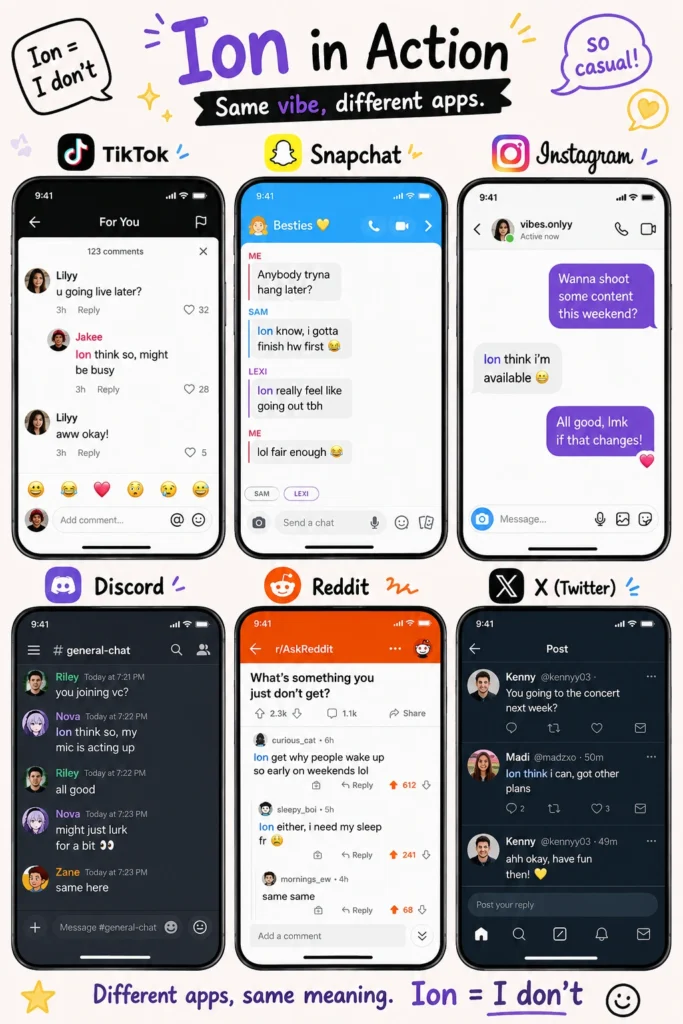
What Does Ion Mean on Different Social Media Platforms?
Although the meaning usually stays the same, the way people use Ion can vary slightly depending on the platform.
Ion on TikTok
TikTok comments move quickly, so users often shorten common phrases.
Example:
Ion think this trend will last long.
Rather than writing the full phrase, the commenter keeps the message brief while maintaining a conversational tone.
Ion on Snapchat
Snapchat is built around casual conversations between friends, making it one of the most common places to see internet slang.
Example:
Ion remember what happened yesterday 😂
The abbreviation fits naturally because Snapchat messages tend to feel informal.
Ion on Instagram
On Instagram, you’ll often find Ion in direct messages, story replies, and comment sections.
Example:
Ion know where you found that café, but it looks amazing.
Ion on X (Formerly Twitter)
Because posts have limited space and conversations move quickly, users often shorten words and phrases.
Example:
Ion believes that actually happened.
Ion on Discord
Gaming and hobby communities on Discord frequently use relaxed language. Seeing Ion in chat messages isn’t unusual, especially among friends who communicate every day.
Ion on Reddit
Reddit users sometimes write Ion in informal discussions, although usage varies depending on the subreddit. Communities focused on memes, entertainment, and pop culture tend to use internet slang more frequently than professional or educational forums.
Ion vs Other Popular Texting Abbreviations
Because internet slang evolves so quickly, it’s easy to confuse Ion with other common expressions. However, each serves a different purpose.
| Abbreviation | Meaning | Typical Use |
| Ion | I don’t | Informal replacement for “I don’t” |
| IDK | I Don’t Know | Expressing uncertainty |
| IDC | I Don’t Care | Showing indifference |
| IMO | In My Opinion | Sharing a personal opinion |
| TBH | To Be Honest | Introducing an honest statement |
Although Ion and IDK both begin with “I don’t,” they aren’t interchangeable.
For example:
✔ Ion think that’s true.
✔ IDK if that’s true.
The first expresses disagreement, while the second expresses uncertainty.
Common Situations Where People Use Ion
People usually write Ion when chatting with friends, family, classmates, or online communities where informal language is expected.
You’ll often see it in conversations about:
- Weekend plans
- Music
- Movies
- School
- Gaming
- Relationships
- Sports
- Daily life
- Social media trends
Because it’s conversational, Ion sounds most natural when everyone involved already understands internet slang.
When Should You Avoid Using Ion?
Even though Ion is popular online, it isn’t appropriate everywhere.
Avoid using it in:
- Professional emails
- Job applications
- Business communication
- Academic papers
- Formal presentations
- Official customer support messages
In those situations, writing “I don’t” in full is clearer and more professional.
Using standard English also reduces the chance of confusing readers who may not be familiar with internet slang.
Mistakes People Make When Reading Ion
Because Ion has multiple meanings outside texting, people occasionally misunderstand it.
Mistake 1: Thinking It’s Related to Science
If you’re reading a chemistry lesson, ion refers to a charged particle.
If you’re reading:
Ion know what you mean.
It’s almost certainly the slang form of “I don’t.”
Mistake 2: Assuming It’s a Typo
Many first-time readers believe someone accidentally misspelt “I don’t.”
In reality, most people who write Ion do so intentionally because it’s part of their casual writing style.
Mistake 3: Using It in Formal Writing
Internet slang doesn’t belong in every situation.
Knowing when to switch back to standard English is an important communication skill, especially in professional and academic settings.
Can Ion Be Misunderstood?
Absolutely. In fact, that’s one of the main reasons this slang term generates so many searches. Someone who spends a lot of time on TikTok or Snapchat will probably recognise Ion immediately, while someone seeing it for the first time may think it’s a typo or a completely different word.
The confusion becomes even greater because ion is already a well-known scientific term. If you search for the word without any context, you’ll likely find chemistry-related results alongside articles about texting slang.
That’s why context is everything. A sentence like “Ion know what you’re talking about” clearly points to the slang meaning, whereas “An ion carries an electrical charge” belongs to science. The surrounding words almost always reveal which meaning is intended.
Does Ion Always Mean “I Don’t”?
For casual texting, social media, and online conversations, yes, that’s the meaning you’ll encounter most often.
However, it’s worth remembering that Ion isn’t a universal abbreviation. Outside internet slang, it may refer to:
- A charged atom or molecule in chemistry.
- Brand names or product names.
- Television networks or organisations that use the word “ION.”
This is why reliable sources always recommend interpreting Ion according to the topic being discussed rather than assuming every appearance has the same meaning.
Why Context Matters More Than the Word Itself
Many internet abbreviations have only one widely accepted meaning. Ion is different because it’s an ordinary English word in one context and a slang expression in another.
Imagine these two sentences:
Sentence A
Ion think she’s coming today.
The writer clearly means:
I don’t think she’s coming today.
Now compare that with:
Sentence B
A positive ion has fewer electrons than protons.
Even though the spelling is identical, the meanings have nothing in common. Looking at the complete sentence prevents confusion and helps you interpret the word correctly.
Should You Use Ion Yourself?
That depends on who you’re talking to.
If you’re chatting with close friends, replying to comments on social media, or messaging people who regularly use internet slang, Ion can feel completely natural.
However, if you’re writing to a teacher, employer, client, or someone you don’t know well, it’s usually better to write “I don’t” in full. Standard English is clearer, more professional, and easier for everyone to understand.
A simple way to decide is to ask yourself:
Would I normally use slang in this conversation?
If the answer is no, write the complete phrase instead.
Tips for Understanding Internet Slang Like Ion
New internet expressions appear every year, but you don’t need to memorise every single one. A few simple habits will help you understand most abbreviations naturally.
- Read the entire sentence instead of focusing on one word.
- Consider which platform you’re using.
- Think about who wrote the message.
- Look for clues in the surrounding conversation.
- Remember that some words have different meanings in different subjects.
Using these strategies makes unfamiliar slang much less confusing, whether you’re reading TikTok comments, Snapchat messages, or Reddit discussions.
Final Thoughts
The first time you see Ion in a text message, it’s easy to assume it’s a typo or a completely unrelated word. In reality, it’s simply a casual way of writing “I don’t,” and its popularity comes from how naturally it reflects everyday speech in online conversations.
Today, you’ll find Ion across platforms like TikTok, Snapchat, Instagram, Discord, Reddit, X, and text messaging apps. While it isn’t appropriate for formal writing, it has become a familiar part of internet culture because it’s quick, conversational, and easy to understand once you know the context.
The next time someone texts “Ion know,” you won’t have to stop and guess what does Ion Mean in Text. You’ll immediately recognise it as an informal version of “I don’t know”, and you’ll also know why context is the key to interpreting it correctly.
FAQs
What does Ion mean in text?
In texting and social media, Ion most commonly means “I don’t.” It’s an informal spelling that reflects how the phrase is often pronounced in casual speech.
Is Ion an abbreviation?
Not in the traditional sense. Unlike abbreviations such as LOL or BRB, Ion is generally considered a phonetic spelling of “I don’t” rather than a group of initials.
Where is Ion most commonly used?
You’ll often see Ion on:
- TikTok
- Snapchat
- X (formerly Twitter)
- Discord
- SMS text messages
It’s most common in casual conversations between friends.
Does Ion always mean “I don’t”?
In texting, yes. However, outside internet slang, ion can also refer to a charged particle in chemistry or appear in company and product names. The surrounding context determines the correct meaning.
Is Ion proper English?
No. Ion is informal internet slang and isn’t considered standard written English. In formal communication, it’s better to write “I don’t” in full.
What’s the difference between Ion and IDK?
Ion means “I don’t”, while IDK means “I don’t know.” They’re related but not interchangeable because IDK expresses uncertainty, whereas Ion can begin many different phrases.
Why do people write Ion instead of I don’t?
Many users type Ion because it mirrors how “I don’t” is pronounced in relaxed, everyday speech. It’s quicker to type and fits the informal style of online conversations.
Should I use Ion in work emails?
No. Professional communication should use standard English. Writing “I don’t” instead of Ion is clearer and more appropriate in formal settings.
Is Ion popular with younger people?
Yes. The slang is especially common among teenagers and young adults who are active on social media, although people of different ages may use it in casual online conversations.
How can I tell whether Ion means slang or science?
Read the full sentence. If the conversation is about texting or social media, Ion almost certainly means “I don’t.” If the discussion involves chemistry or physics, it’s referring to an electrically charged atom or molecule.
A